Reading Doors

Showing posts with label summer. Show all posts

Tuesday, July 12, 2016

My Summer Reading List Challenge 2016

As with most things this summer, my summer reading list (and posting about it) has gotten away from me. This year, as I did last year, I asked my 4th grade students at the end of the year to give me book title suggestions for my summer reading list, promising that I would read each one and at least the first book if it was a series. The only exception to this promise is if I've already read the book recently, about the last 5 years or so. They took up the challenge with gusto! Below is the list they gave me:
The very extensive list includes (those in red I've already completed this summer):

  • Garden of the Purple Dragon
  • Where the Red Fern Grows
  • Katie John
  • The White Giraffe
  • America's Funny But True History
  • Camp Rock 2: Final Jam
  • Life of Pi
  • Sugar
  • Lego Ninjago: Masters of Spinjitzu
  • Toes
  • Half Magic
  • Star Darlings
  • 39 Clues
  • Little House on the Prairie
  • Ruby Lee and Me
  • Marley
  • The Cupcake Queen
  • The Light in the Forest
  • Fortune Falls
  • Pie
  • The Hunger Games
  • Roller Girl
  • Thimble Summer
  • Shadow of the Dragon: Kira
  • World War II Book 2: Dead in the Water
  • Pegasus
  • Mutation
  • Five Little Peppers series
  • Frostborn (Thrones & Bones)
  • Evermore
  • The Lost Track of Time
  • Beholding Bee
  • Crimebiters! series
  • Haunted Houses
  • A Night Divided
  • Seekers: The Quest Begins
  • Dog Diaries series
  • Colorado Sam (written by a student's grandfather)
  • The Twelve Dancing Princesses
  • The Puppy Place
  • Lincoln's Grave Robbers
  • Silver Pony Ranch
  • Dragon Keeper
  • Tombquest series
  • Spirit Animals
WOW!! What a list! They have challenged me to read about 21 more books this summer than the students last year did.

And of course, I always have a huge stack of my own that I have set aside for summer, including several professional development books. (below left)

This summer has gotten away from me and I've spent far more time travelling than is typical, so I even have a stack I've been saving that I know will have to wait until the school year, or much more likely, until next summer. (above right)

Well, with half the summer gone I have only gotten through about 45% of the books I want to read, and less than 20% of the books I've been challenged to read. It is time for me to buckle down and make a greater effort to read the books my students have recommended. I do not want to let them down, and have spent too much time reading the books I had in my own stack. Hopefully I will do better the remainder of the summer. If I promised my students that I'd read it, then I will keep that promise!

Monday, July 11, 2016

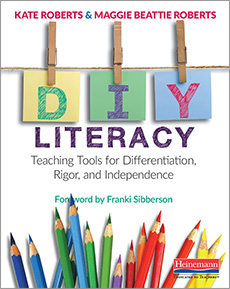
DIY Literacy Ch. 3-4 Reflection #CyberPD


"We find that students need support, time, and repetition to make learning stick." pg 39

This week, reading Chapters 3 & 4 of DIY Literacy by Kate Roberts & Maggie Beattie Roberts really hit home with some of the struggles I have with my students every year. Getting students to remember what I've taught and helping them reach a level of rigor in their independent work are constant struggles I have with some of my students.

In recent years, our school district's poverty level has more than double from less than 30% free or reduced lunch to roughly 65%. Although I know many district's live with these levels year after year or are in situations with higher levels than we have, it has still been a culture shift for us. What once worked to motivate students simply does not any longer. Most of our students live in homes that value entertainment and fun over buckling down to achieve academic success. With this change, memory and motivation are now key struggles for our district as a whole, and these chapters fit perfectly with the PD within our districts.

I love how Kate & Maggie show, through explicit examples, how each of the tools they describe can be used to help improve student memory, rigor, and independence. The How to Set Goals and Narrow Our Focus section on page 43 was especially helpful. Keeping in mind our list of ideas and goals, students get a sense of ownership when co-creating the tools, but we as teachers are still able to ensure the best quality teaching goes onto the tools. Such great tips!

"Watching the process of something being made increases the likelihood that students can replicate the process on their own, which is critical to their independence." pg 68

I'm also starting to get really excited about the idea of using micro-progressions in full-force within my classroom. In the past I have used something similar but rather infrequently. I have liked how it worked but I still knew it was not as successful as it could have been. The tips and ideas from these chapters are what I needed to really implement good quality micro-progressions.

"The point is that you keep trying, and work hard, not that it works perfectly for you right away." pg 64

Further Questions I Have:

  1. As many others have asked, how many demonstration notebooks would be the most beneficial? Would having separate reading and writing notebooks be best, or would it be better to keep them together as one since much of reading and writing overlaps?
  2. I have seen many examples from middle school grades, but as my new coaching position will take me into classrooms ranging from K-6th, I would like to look more into ideas for a demonstration notebook for the younger grades, for those students who are still learning how to read.

Wednesday, July 6, 2016

DIY Literacy Ch. 1-2 +Bonus Reflection #CyberPD


Another year of #CyberPD has officially begun! I always look forward to this online learning event with other educators who are eager to share and learn together, This year's chose book title is DIY Literacy by Kate Robins & Maggie Beattie Roberts. If not already a member of this great community of educators and life-long learners, check it out here.

"The tools in our lives improves our lives. They save us energy, time, and struggle." pg. 3

This book hits such an important topic that I have always struggled with: how to create effective and visually stimulating tools that truly invigorate the students to work independently. As a 4th grade teacher, I am always striving to get the children that come into my room at the start of the year to grow into independent thinkers and problem solvers.

Chapter One: Extending Our Reach
I love how chapter one starts out. It reminds us that the right tool is essential to success in most situations. Something that I love to do is cook. When I first started to experiment with made from scratch foods, I had limited kitchen tools and it became very difficult to create the delicious foods I wanted. It quickly became obvious to me that it was essential that I purchase certain kitchen tools, such as a rolling pin, different sized graters, a mandolin, and most importantly a food processor. With these, cooking became so much easier and I was able to complete more complex and delicious foods. As a cook, I knew these tools were helpful and allowed me to combine the skills of using these in many different ways to create new dishes. The same is true in the classroom. With the right tools, students can succeed and become independent. And the more tools we provide, the more likely that the students' learning will be complex and lasting.


Chapter Two: An Introduction to Teaching Tools
I currently have my students each keep a notebook in the classroom that is full of the notes, examples, lists, and other helpful tools. It stays in the classroom where they can access it whenever they need to while working. However, as I get into this book, I am realizing that it is lacking some key ingredients. First, it is definitely not interactive enough. Although many of the examples of good, "after" work are created together, I have never had students create their own bookmark list of strategies that work for them, rather, every strategy that is an option is always included in the tools. Second, I need to use more images, icons, and other visual clue elements. Third, I need to include far more examples of the "before" work so that students can see where they are now in order to figure out how to get to better and reach quality "after" work.

My favorite tool that is shown in Ch. 2 is the demonstration notebook. I always struggle with making my mini-lessons truly mini, and with being able to timely pull out small groups for effective reteaching or refining lessons. The demonstration notebook is a great solution to both of these struggles. It allows me to be ready with hands-on practice of valuable skills and strategies for when the need presents itself in the classroom. I am getting excited about starting to create my notebook and other charts! I know it will take time to create a quality notebook and truly beneficial charts and micro-progressions, but it will be worth it!

Bonus Chapter: How Do I Find (and Write) Strategies for Teaching Tools?
This chapter was more of a confirmation that I have been on the right track for the past 4-5 years. My district has been going through major curriculum changes the past few years as the Common Core standards are introduced and as the state tests have changed over and over. In order to compensate, I have done a lot of finding and writing my own strategies for my students' ELA binders. I especially appreciate the Fine-Tuning Your Strategies section. These were great reminders to help make the strategies I give to students truly kid-friendly. It really is all about the kids!

I want to end with this great reminder found on page 6: "You will also need good teaching practices, a strong curriculum, and solid relationships with your kids."


Tuesday, August 18, 2015

My Summer Reading...Summer is Over Update

At the start of the summer, I shared a post explaining how my students had been allowed to choose many of the books on my summer reading list this year. You can see the post here.

As summer has now come to an end and the 2015-2016 school year is about to begin, I find myself reflecting on what I did, and read, over the summer months. I had promised my students that any book they wrote down, that I had not already read, I would get done this summer. This helped to spur me on as I read more books in one summer than I ever have before. I couldn't let them down (they had been so excited to control what I read and wanted me to read the best of what they liked) and I wanted to be sure to set a good example. I told my students that if I liked the first book of a series, I'd keep reading, but if not, I would only read the first one. 

Here is the list of books my students placed on my reading list:
  • NBA Playbook by Fred Kerber
  • Fangbone: Third-Grade Barbarian by Michael Rex
  • I am LeBron James by Grace Norwich
  • Animal Ark: Dog at the Door by Ben B, Baglio
  • Dinkin Dings by Guy Bass
  • Snoop Troop by Kirk Scroggs
  • Superstars of History: The Good, The Bad, and The Brainy by R.J. Grant
  • A Series of Unfortunate Events by Lemony Snicket
  • Harry Potter series by J.K. Rowling
  • Divergent by Veronica Roth
  • Dork Diaries by Rachel Renee Russell
  • Bone series by Jeff Smith
  • So B. It by Sarah Weeks
  • How to Steal a Dog by Barbara O'Connor
  • Spiderwick Chronicles by Tony DiTerlizzi & Holly Black
  • A Dog Called Kitty by Bill Wallace
  • The Wickit Chronicles: Ely Plot by Joan Lennon
  • Jungle of Bones by Ben Mikaelson
  • Percy Jackson and the Olympians by Rick Riordan
  • Deadtime Stories: Little Magic Shop of Horrors by Annette & Gina Cascone
  • any I Am...books or Who was...books
 I am proud to say that I didn't let my students down, and read every book that they put on my list.

Some of the series were really good, and I kept reading. This included the Harry Potter series, the Bone graphic novel series, and the Spiderwick Chronicles. I read the first two Percy Jackson books, but did not read beyond that. Book series that I did not love, and so only read the first book, included A Series of Unfortunate Events, Dork Diaries, Divergent, and The Wickit Chronicles.

I am glad to say that, even though I did not love every book my students put on my list, I did not hate any of them either. My students have some really good tastes in books and did not disappoint or provide me with a boring summer. I look forward to requesting another summer reading list in May from mt new classes of 4th graders!

Wednesday, July 22, 2015

Digital Reading Ch. 6-7 Reflection - #CyberPD

As with last year, I have had such a great and fun learning experience through this summer's #cyberPD and I'm sad to find that it is almost over. Here is my last reflection for Digital Reading: What's Essential in Grades 3-8 by William L. Bass II and Franki Sibberson.

Chapter 6: Assessment: Keeping Our Eye on the Literacy

"Assessment should not be about defining a reader but about piecing together information to help us design classroom experiences so we can observe our readers learning and understand what each one needs." (pg. 87)

What a great way to start a chapter! I really appreciated the story about Franki's daughter Ana learning about Minecraft in so many authentic and digital ways. This story reminds me of so many of my students, who have been addicted with and almost obsessed with Minecraft. This story illustrates so perfectly how our students use technology in meaningful ways without realizing they do so because it is not the "traditional" way it's used in schools. I would like to start a conversation with my students about their own research and reading lives, using a similar topic or example.

Overall I found this chapter very reassuring, as I have always felt that one of my strengths is using formative assessments to fully understand my students' needs and planning the next steps for learning accordingly. My district is a Google Apps for Education school, and as such, we use Google for almost everything, with each student having their own Google Suites account through the school. The reading teachers have digital portfolios for each kid that are easily shared with next year's teachers through Google Sheets. We utilize Google Classroom in small ways, increasing its use as we become more familiar with it. I experimented with giving assessments on Google Forms for about a month last year (before a series of storms sent the power out every hour or so, shutting computers down, and the computer-based tests started and took away all access to computers that I had). Students begin using Google Docs to create shared projects that they can work on while in separate locations in 4th and 5th grade. 

Some things I plan to add to my classroom this year in order to increase authenticity, intentionality, and connectedness (and that can also be used for assessment):

  • Kidblog
  • Wonderopolis
  • Global Read Aloud
  • increase use of Google Forms for surveys, check-ins, and assessments

"We assess digital literacy as we have always assessed print-based literacy." (pg. 90)


Chapter 7: Beyond the Classroom Walls: Connecting Digital Reading at Home and School

As much as Chapter 6 was affirmation that what I have already been doing is good, Chapter 7 focuses on an area that I, and my building/district as a whole, struggles with. We have taken measures in the last year or so to rectify this, but we still have a long way to go. 

Part of the struggle is that we are located in an area where most families do not have a computer of any kind in their home. Many other households in the area have computers or similar devices, but do not allow their children to use them. I think this comes from the lack of understanding the parents have for these devices and their potential, as so the parents fear the technology and what their kids may do on the devices without the parents knowing or knowing how to stop them. Our school needs to focus on educating these parents, guardians, and families in order to decrease the gap between the students who have and those who have not. I loved the idea of an Internet Safety Night discussed on pages 102-103.

Last year our district had each building create a Facebook account through which we can share updates, photos, and videos about individual classroom activities and whole building events. Every teacher is also provided with their own classroom website through the district site. This has always been my classroom hub, but I spent some time after reading this book updating the format and adding to it in order to best utilize the space provided.


"Knowing that all of them may not “take off” and that I may need to add something that seems missing later in the school year, I can be flexible and use what works for both my students and their families. The key is having a plan with goals for communication that supports literacy in multiple ways and involves families as digital readers." (pg. 108)


Sunday, July 12, 2015

Digital Reading Ch. 3-5 Reflection - #CyberPD


In Chapters 3-5 of Digital Reading: What's Essential in Grades 3-8 by William L. Bass II and Franki Sibberson the focus is on authenticity, intentionality, and connectedness. These three concepts must be present in order to develop students who have a deep understanding of the intricacies of digital reading. (I also found these chapters very engaging and wrote a lot more than I intended, for which I apologize.)

Chapter 3: What Really Matters? Authenticity


Authenticity means making it real, and something students may encounter or choose to do outside the classroom. It means giving students a choice in their reading work, because every student finds meaning from their reading in different ways, even in a digital world. Achieving true authenticity within the classroom can be a challenge when there are 20-30 students who all have different ways of absorbing, synthesizing, and sharing information. However, within our ever changing technological world, authenticity is so important to helping students become truly capable and productive members of society.


We need to remember that, although we may be comfortable with many different forms of technology and the tools that go with them, our students may not be. We can not assume they know what we know, simply because these tools have always been present in these students' worlds. 

"It is also easy to assume—erroneously—that our students have these skills and can easily transfer them to school." (pg. 29)

My favorite line in this chapter is one that I need to always have in mind in order to bring authentic digital learning into my classroom. "As we focus more on authentic digital reading, we must continue

to ask ourselves questions about our own reading lives so that we can make sure the things we are teaching our students are relevant in and out of school." (pg. 30)

In last weeks reflection I stated that "As I plan my teaching and instruction, I need to ask myself, 'Am I sharing my own process and consumption of digital texts with my students? Am I making this authentic and real?'" This chapter reaffirmed this thought. Am I sharing my own thought process and why I do what I do with technology and with my reading?


"Authenticity is what connects the work of school to the work of being a reader, helping students learn to embrace their reading lives." (pg. 43)


Chapter 4: What Really Matters? Becoming Intentional Decision Makers


In this chapter I really thought a lot about the opportunities that I can and do provide for my students. Simply sharing the available types of digital reading and tools with my students is not enough. They must have time to use these tools and texts in authentic ways of their choosing. I can not simply think they will learn just from watching me or that they will learn if I ask them all to do the same thing with the same tools at the same time. 

I must be intentional in my choice of texts and tools for the classroom, both in print and digitally, but I must also be intentional in providing time for authentic use of these text and tools. On page 51 there is a list of questions we should consider when planning how to use our time wisely. The ones that struck me the most stated, "How are learning tasks assigned? Are most assignments pencil and paper, or are digital tools part of the expectation? Are all students expected to do the same tasks on digital tools, or are they given choices in how to complete their assignments?" These are the questions that I need to remember and need to be intentional about considering when planning.

This chapter was choked full of ideas I want to try in my classroom:
I loved the Voices from the Classroom section on Wonderopolis and it's uses in Maria Caplin's classroom on pages 53-55. I have added several of her ideas to my notes for the upcoming school year.

I also found the Voices from the Classroom section on Learning to Read Critically incredibly powerful and useful. I also teach 4th grade students, and I can't wait to try this with them in the coming year!

"In the digital age, it’s not important for the teacher or the students to be familiar with every tool available. What’s important is the collective knowledge of the class and the power of each student bringing his or her own strategies, understanding, and reading experience to the classroom community." (pg. 64)

Chapter 5: What Really Matters? Connectedness

I really felt that this chapter piggy-backed off of Chapter 4 so well! It seemed to be an extension of the conversation about making intentional choices, but simply added in the specific intentional choices educators must make when helping to build a connected classroom. I especially appreciated the many, many resources that were provided and explained (explained being the big help for me). I have such a long list of ideas I want to learn more about and hopefully implement or try as the year progresses.

I love the statement that when educators provide several different ways for our classes to connect, students "begin to see connecting as a natural part of their reading, writing, and learning, and they begin to expect to learn with the world and not just about it." (pg. 76) This statement was a reminder and call to action for me to include the authentic, intentional, and connected digital experiences for my students simply because it is what is best for them.

This connectedness must also extend from simply connecting our classrooms to connecting various texts. This part of the connectedness focus I have had more experience and exposure with, as it is a big focus of the Common Core Standards that my district transitioned to a few years ago. I often use videos and text with Scholastic News articles throughout the year, both to initiate writing activities as well as simply having class discussions. However, I will need to work on expanding the ways I connect various types of texts within these digital literacy experiences. 

"Community and connectedness are bigger than a group of people. Rather, they are a way of thinking and being active in all that we consume and create." (pg. 79)

Tuesday, July 7, 2015

Digital Reading Ch. 1-2 Reflection - #CyberPD


Another summer of #cyberPD has started and I'm very excited to be a part of this community again and the conversations that develop! If not already a member of this great community, check it out here.

I have always loved technology and the many things that it makes possible, but implementing its use within my classroom, though a priority, has always been a challenge. I do not have a 1:1 classroom, and in fact only have two outdated desktop computers in my room. Most of my 4th grade students do not have their own tablets or iPads, a larger portion have their own cellphones, with limited permissions from parents, but most can not afford the technology that our school Bring Your Own Device policy allows them to bring to school. It is because of this struggle to even find technology for my students to utilize that I am always eager to read about how to best implement digital devices and to teach digital literacy.

If my students only have limited exposure and access to current digital devices, then the time they do spend with it needs to be of the highest quality. 

Chapter 1: Defining Digital Reading

This chapter began with such a vivid description of two seemingly digitally literate students, Julia and Marissa. This image really hit home. Every year I have many students who are just like Marissa, digitally literate if taken at face value, but who have not truly established deep reading habits like those of Julia. 


As with most everything, students, though having grown up with technology and understanding it's superficial uses, must be taught how to choose which tools are best, how to use these tools, and what other tools may be out there. Students understand games and apps, but little beyond that. How can students be expected to know and understand these digital tools, if we do not teach them? I must make it a part of my classroom procedures and schedules. I must not just use technology in my own life, but must constantly show my students that I do, taking the time to explain why and provide time for them to try these devices and tools as well. To this end, I love the reminder on page 8 that "we can't wait until a child is competent with traditional literacy skills and then expect the child to transfer those skills to digital reading."

Throughout these first chapters, I have been thrilled with the information in the figures and tables. I especially like Figure 1.3 on page 10. This table shows the traditional skills we've always taught and how these skills expand or change with digital reading. What a great tool for use when planning for integrated and embedded digital learning!

A few key lines I loved:
"But it is important to stay true to what we know about good literacy teaching: teaching that teaches the reader, not the text." (pg. 12)

"This is not an either/or conversation; we don’t want to abandon books completely, and we also don’t want to imply that we should access only digital texts." (pg. 13)

Chapter 2: From Reading Workshop to Digital Reading Workshop

The second chapter of this book focuses on turning a reading workshop, into a digital reading workshop, and starts with reaffirming the choice to use a workshop. Put simply, it works. Students are invited to be a part of a community with authentic reading activities, and even in a digital world, this is still what students need. We can't turn away from what we know helps students grow.

I, on occasion, use digital texts within my classroom instruction, but as I read this chapter, I realized how much more I need to incorporate a wide variety of digital texts in order to have the impact on students that I desire. As I plan my teaching and instruction, I need to ask myself, "Am I sharing my own process and consumption of digital texts with my students? Am I making this authentic and real?" My students will learn from my example, but not if they don't see how I live out my reading life.

As with Chapter 1, so many of the tables spoke volumes to me. One of the best figures in this chapter was Figure 2.3, which compared a traditional workshop to a digital workshop, highlighting the small but vital changes that are needed. It may be a challenge, but making the transition from traditional reading instruction to digital reading instruction is critical in achieving the best education for my students.

"We want our students to be authentic readers and, at the same time, to be intentional, active, and reflective as they read all forms of media." (pg. 22)


Sunday, May 31, 2015

My Summer Reading List Challenge 2015

This year, I did something a little different with my summer reading list. Typically, I make my own list based on whatever I've had sitting around during the school year but never seemed to get to and on any new books that I got for my classroom towards the end of the year. I also add titles for book clubs and any professional development I have planned over the summer months. However, at the end of this school year, I decided to let my students make the majority of my list for me.

I put the title My Summer Reading List up on my whiteboard two days before the end of the school year and told my students that I wanted them to add titles that they really enjoyed and thought I should read as well. The exception being that I would remove the title only if I had already read it recently. My students loved this opportunity to tell their teacher what to read. Many of the titles were already on my own list, as though the students knew what I wanted to read.

Here is a partial list. Several that were already on my own list had been taken off as I gathered them from my shelves.
In addition to the books listed in the photo, they also added the following titles:

  • NBA Playbook by Fred Kerber
  • Fangbone: Third-Grade Barbarian by Michael Rex
  • I am LeBron James by Grace Norwich
  • Animal Ark: Dog at the Door by Ben B, Baglio
  • Dinkin Dings by Guy Bass
  • Snoop Troop by Kirk Scroggs
  • Superstars of History: The Good, The Bad, and The Brainy by R.J. Grant
  • A Series of Unfortunate Events by Lemony Snicket
In addition to the many books my students have requested, and even challenged, me to read, I have added the following:
  • Sadako and the Thousand Paper Cranes by Eleanor Coerr
  • Chocolate Fever by Robert Kimmel Smith
  • Ida B by Katherine Hannigan
  • Little Dog Lost by Marion Dane Bauer
  • The Mouse and the Motorcycle (and sequels) by Beverly Cleary
  • King George: What was His Problem? by Steve Sheinkin
  • Outside the Box: A Book of Poems by Karma Wilson
  • The Counterfeit Constitution Mystery/The Mystery on the Underground Railroad by Carole Marsh
  • Loot by Jude Watson
  • Love That Dog by Sharon Creech
  • Life on Mars by Jennifer Brown
  • A Snicker of Magic by Natalie Lloyd
  • City of Lost Dreams by Magnus Flyte
  • On the Road by Jack Kerouac
  • Yes, Please by Amy Poehler
  • Is Everyone Hanging Out Without Me? (And Other Concerns) by Mindy Kaling 
Many of the books I've added to my own list are books I am re-reading, having read the book years ago. I am very happy with the list my students and I have come up with, and I will be very excited to be able to show my students that they had a direct hand in what I did over my summer, and that I was able to read all the books they asked me too.

Saturday, May 30, 2015

Another Year Comes to an End

It has been one very hectic year, full of ups and downs. At times it dragged on for what seemed like forever, while at other times the days flew by in a blur. Now, with the school year officially wrapped up, I can look back and know that a lot was accomplished and that my students will be moving on to fifth grade with more knowledge than when they came to me, academically and socially. I look back on a successful school year and forward to the possibilities held in the upcoming year. 

In between, though, is an entire summer open and free. A summer filled, undoubtedly, with countless days of reading and innumerable books enjoyed, of CyberPD and Book Clubs, of spontaneous weekend road trips, and of time spend in the gardens. I am greatly looking forward to a summer of rest, relaxation, and working on tasks of my own choosing. I have not used my blog in quite some time, and that is one of the many things I'd like to improve upon over the summer. 

Now to go read wildly! Until next writing...