It has been one very hectic year, full of ups and downs. At times it dragged on for what seemed like forever, while at other times the days flew by in a blur. Now, with the school year officially wrapped up, I can look back and know that a lot was accomplished and that my students will be moving on to fifth grade with more knowledge than when they came to me, academically and socially. I look back on a successful school year and forward to the possibilities held in the upcoming year.
In between, though, is an entire summer open and free. A summer filled, undoubtedly, with countless days of reading and innumerable books enjoyed, of CyberPD and Book Clubs, of spontaneous weekend road trips, and of time spend in the gardens. I am greatly looking forward to a summer of rest, relaxation, and working on tasks of my own choosing. I have not used my blog in quite some time, and that is one of the many things I'd like to improve upon over the summer.
Now to go read wildly! Until next writing...
Showing posts with label #rvlsd. Show all posts
Showing posts with label #rvlsd. Show all posts
Saturday, May 30, 2015

Tuesday, February 10, 2015
College and Career Ready at Keene: Journalism

Currently, there is a large focus in education on getting students "college and career ready." The standards all push students towards increased deduction skills, problem solving abilities, and critical thinking in order to help them along in the 21st century. As teachers, we are expected to expose the students to every opportunity, and to show them the diversity of options available to them, as well as prepare them for every possible path they may choose.
But what does this really mean? What is it to make our students "college and career ready"? There are a lot of sources that can be found on what these mean and the importance they have in our education system, especially in this ever changing technological world. I spent a good bit of professional development time, when Common Core and Ohio's New Learning Standards were first introduced, collaborating and learning with colleagues about getting students college and career ready.
Yet, none of these books or studies is the same as seeing it within someone's classroom. I, and my district, strive to engage the students in real-world activities and to expose our students to many different college options and potential careers. As part of this, we often have guests come in or use tools, such as Google Hangouts, to bring professionals into the school to talk with the students. These experiences will become a recurring blog strand that I call "College and Career Ready at Keene."
College and Career Ready at Keene: Journalism
In January, the 4th-6th graders at Keene Elementary were visited for the day by Mr. H, a journalist at the local newspaper. He spent a little over an hour with each class, sharing with them what he does each day, the places his job has taken him and the people he has gotten to meet or talk to. He also presented a lesson on how to write the first five paragraphs of a news article, what he called the "First 5 Graphs." He had prepared several hand outs that outlined each paragraph, what normally is included, and why that information is important to a news article. He talked about the value of "hooking" a reader so that they will want to read it and will continue to purchase the newspaper. An example article was provided, as well as several copies of the newspaper from the previous week.
Then the students got to write their own article for an imaginary Keene Elementary newspaper. The students wrote their own first five graphs and had Mr. H and myself available to help. One of the most important ideas that Mr. H stressed throughout this process was the importance of editing, editing, editing. Making your work better takes time and requires you to look at what you have done critically and self-reflectively. Perfection is never achieved the first time around, but comes after much practice, refinement, and trail and error.
The students had a great time getting to know Mr. H and had an abundance of questions for him about his job and the many things he has gotten to see and do. They enjoyed writing an real-world news article and did not want their time with this special guest to end. When we began writing news articles about Martin Luther King Jr. Day the following week, they all began working harder and taking it more seriously when I told them I'd send the two best articles to Mr. H. Most importantly, my several of my students have been inspired and want to enter a career in journalism.
Slice of Life: Technology Safety Lesson

As part of my district's technology classes, we use a site called Learning.com to complete several internet and technology safety lessons with the students. These lessons cover things such as text and cell phone safety, identify theft, and cyber bullying. This technology curriculum is a requirement for every grade level within our district.
My classes have finished many of the online lessons involved with this course, and this past week we were working on one of the class discussion lessons that does not require the internet or computers. Normally these class discussion lessons are dull and the students lose interest in just talking about texting safety. To help alleviate this monotony, I created an awareness week poster assignment that students can create to teach other grades about texting safety. The first day of the lesson, however, is simply going through lists of safety guidelines and precautionary measures to take. I have always thought this first part seemed a little dull, despite it's necessity. In the middle of this first lesson, one of the students stopped me.
"Wow, Miss Kopec, you're making this a lot of fun!" he said. At first I thought he was being sarcastic, which was a surprise, as sarcasm goes over many of my students' heads.
"Really? What makes this so much fun?" I asked.
"Yeah, it is. I don't know. You're just making it fun."
Wow. He couldn't explain exactly why this lesson was so much fun, but he very much meant it when he said it. It made me feel good to know that I succeeded in making a potentially boring lesson more interesting for the students. I thought about this a lot the rest of that day, and since. We were talking about cell phones, texting, and all the different apps one could have. I think they liked it because it was something they interact with every day. They wanted to talk about what they knew, and they already knew a lot. They wanted to share with me experiences they had with scams or fake texts that they had handled well. Sharing these real-world experiences and lessons was what made it fun for them. It had a deep meaning to them.
My classes have finished many of the online lessons involved with this course, and this past week we were working on one of the class discussion lessons that does not require the internet or computers. Normally these class discussion lessons are dull and the students lose interest in just talking about texting safety. To help alleviate this monotony, I created an awareness week poster assignment that students can create to teach other grades about texting safety. The first day of the lesson, however, is simply going through lists of safety guidelines and precautionary measures to take. I have always thought this first part seemed a little dull, despite it's necessity. In the middle of this first lesson, one of the students stopped me.
"Wow, Miss Kopec, you're making this a lot of fun!" he said. At first I thought he was being sarcastic, which was a surprise, as sarcasm goes over many of my students' heads.
"Really? What makes this so much fun?" I asked.
"Yeah, it is. I don't know. You're just making it fun."
Wow. He couldn't explain exactly why this lesson was so much fun, but he very much meant it when he said it. It made me feel good to know that I succeeded in making a potentially boring lesson more interesting for the students. I thought about this a lot the rest of that day, and since. We were talking about cell phones, texting, and all the different apps one could have. I think they liked it because it was something they interact with every day. They wanted to talk about what they knew, and they already knew a lot. They wanted to share with me experiences they had with scams or fake texts that they had handled well. Sharing these real-world experiences and lessons was what made it fun for them. It had a deep meaning to them.
Wednesday, November 12, 2014
African Children's Choir Performs
Today, the students at the various River View Local School District elementary buildings got the unique and special chance to watch the African Children's Choir from Uganda. This choir has been in existence for 30 years. They help "Africa's most vulnerable children today, so they can help Africa tomorrow." I have added a link here to their web page.

 Not only did the students get to watch a great show choir, but they also learned a little about Uganda and the children's lives there, as well as the children's dreams and aspirations. The children wanted to be doctors, lawyers, pastors, judges, accountants, pilots, and even teachers. Two of the choir members shared what their home lives were like in Uganda. Some of them lived with families of 5 in a one room house. The choir director reminded our students that not everyone in the world has houses like we do.
In the words of my principal, "It wasn't just the performance, it was how the kids carried and handled themselves that spoke volumes to me. To hear them talk about their aspirations and what they wanted to become when they grew up truly touched my heart." Talk about living a "rich" life. "These kids get it. They make the most out of what they have, instead of focusing and worrying about what they don't have. Our students learned a lot from this experience."

All of my students had a wonderful time at the concert. They were enthralled by the performance and by the lives of these kids. If they could have, I'm sure they would have asked all of the children to come back to the school and spend several days with in our classroom. Over and over again, I heard my students say "This is so cool." What an affirmation that the experiences we try to provide for students are worthwhile!
Tuesday, September 16, 2014
Slice of Life: Agricultural Awareness

This year, like every year that I've been in my district, my 4th grade students got to take a field trip at the start of the year to the local fairgrounds for the 4th grade Agricultural Awareness Day event. During this event, the students rotate through 15 minute sessions with their classes, learning about the many different aspects of agriculture specific to our county and state.

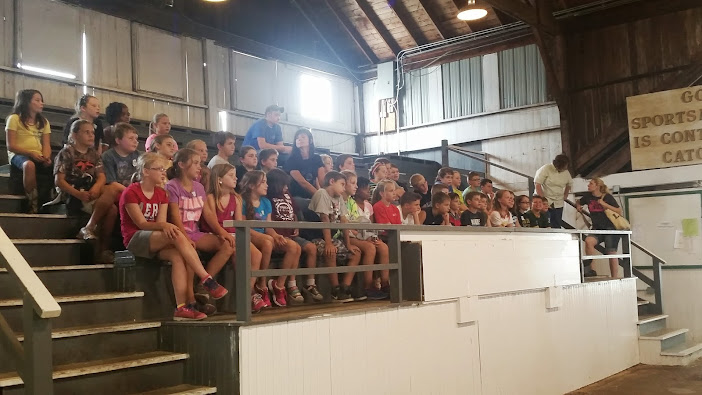
The Ag Day trip is always a favorite of my students and this year was no different. The weather was a big muggy within the barns, but beautiful when outside. I appreciate the groups and individuals that spend their time preparing this learning experience and the people who volunteer their time to spend the day with the children. What a great way for our students to learn about their community, the environment, and the careers that are available to them. (The photos that I have included are from our 15 minute dairy cow session.)
Saturday, August 16, 2014
Reading Doors
Over the summer, I read the book Reading in the Wild by Donalyn Miller, along with many of my colleagues, and took part in this summer's #cyberPD of the book. I enjoyed every minute reading the book and found many useful tools and ideas to implement in my own classroom.
One of these ideas immediately struck me as something that would greatly benefit not only my classroom, but out entire building. Reading Doors. Donalyn explains in her book that school staff in her building utilize door space at the start of the year and decorate their doors with the materials they read over the summer. Donalyn goes a step further and allows her students to decorate the door with books they love a few weeks into the school year. What a great way to visually show students the importance of an active, wild reading life!
 I decided that this would fit perfectly with the goals and focus of our building and asked that everyone start the year off with a summer reading door. What a great response I got! Many were excited and had thought the same when reading the book. Some weren't sure how to create a summer reading door when they don't read books often. I offered my help to any who needed it and tried to brainstorm ideas for materials with those who seldom picked up a traditional novel.
As the school year has started for teachers, and will soon start for students, the doors are almost all covered now. I got to share the purpose of these doors with all of the parents and students present at open house last night, encouraging them to beginning conversations with their children about the materials on the doors. Although much of what our staff read was traditional books, we also have e-readers, tablets, blogs, magazines, newspapers, brochures, playbills, and postcards displayed on various doors. Keeping with our focus of creating a family reading community, many teachers have used their doors to showcase what they read with their children over the summer. Several of us have two classroom doors and are keeping one reserved for our students to create a class summer reading door.
 Not all of the doors are completed yet, as our students don't start until Wednesday, but already it has created an atmosphere of reading and truly shows the value of reading in everyone's life. I'm very happy with how well this has gone. It has been a little more work on my part, helping so many of my colleagues in order to get this done, but it is every bit worth it.
I plan on having more photos of all the doors up soon and of writing a Part 2 that shows the doors that our students make once the year begins.
UPDATE Aug. 21, 2014: A slideshow of the reading doors has been added to the top of my blog.
One of these ideas immediately struck me as something that would greatly benefit not only my classroom, but out entire building. Reading Doors. Donalyn explains in her book that school staff in her building utilize door space at the start of the year and decorate their doors with the materials they read over the summer. Donalyn goes a step further and allows her students to decorate the door with books they love a few weeks into the school year. What a great way to visually show students the importance of an active, wild reading life!
As the school year has started for teachers, and will soon start for students, the doors are almost all covered now. I got to share the purpose of these doors with all of the parents and students present at open house last night, encouraging them to beginning conversations with their children about the materials on the doors. Although much of what our staff read was traditional books, we also have e-readers, tablets, blogs, magazines, newspapers, brochures, playbills, and postcards displayed on various doors. Keeping with our focus of creating a family reading community, many teachers have used their doors to showcase what they read with their children over the summer. Several of us have two classroom doors and are keeping one reserved for our students to create a class summer reading door.
I plan on having more photos of all the doors up soon and of writing a Part 2 that shows the doors that our students make once the year begins.
UPDATE Aug. 21, 2014: A slideshow of the reading doors has been added to the top of my blog.
Subscribe to:
Posts (Atom)